

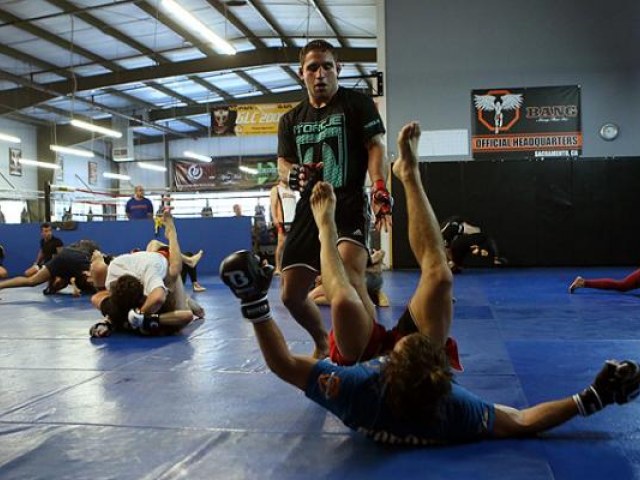

Searching for an MMA gym that fits your style, capitalizes on your strengths and helps improve your weaknesses is a process. Find one that does all three can be a daunting task for those with limited resources and monetary finances. For those fighters who fit that bill, they are left with the scraps: serviceable but eary training facility, usable but old and worn out equipment and good but non-renown coaches.
Still, those who can’t afford the Jackson-Winkeljohn‘s, Duane Ludwig‘s and American Top Teams of the world can receive beneficial training for their upcoming fight. It’s all about finding the guy or gal who fits the bill just right. It’s a prevalent evaluation after many gyms are left divided by one fight or those around the trouble maker feel the need to take out the trash.
But for all the anonymous situations concerning Melvin Guillard, there are simply those who focus primarily on finding their fight home and fitting right in. At the end of the day, it’s all about getting to the fight in tip top shape, feeling fresh, relaxed and well-trained with a full arsenal in the tank.
Thus, I’ve come up with five helpful tips at finding the right MMA gym and training partner that can be followed on any level, from the amateur circuit all the way to the pros. Here they are.
~ Tip #1: Gym Success Rate ~
This is perhaps the biggest one of them all. In finding the right gym, you want to find out just how far you can go. In order to do that, perhaps it would be helpful to find out how far others have gone before you. This is a great indicator of what the expectations the gym has for you. If a former fighter who came up the ranks is now fighting for title belts in the UFC, Bellator or World Series of Fighting, it may be enticing to sign on the dotted line.
However, if the gym has a history of stagnation, abandoning talent at the infant stages or if the fighters never garner the skills to progress to the pro level, then it can be enticing to look elsewhere. Not only is it about how much work you put in, but also how much you can get out of it.
~ Tip #2: Equipment and Resources ~
Is there a wide variety of equipment? Is it clean and sanitary? It’s not a foregone conclusion that every mat and dumbbell is bacteria-free. You’d be surprised at how much little care some gyms, trainers and fighters take care of their equipment. If the mat gets torn up and it’s not in the budget to be replaced, then chances are you’re going to have to train on that surface and risk injuring yourself or others.
Staph infections are also commonplace when it comes to open cuts and wounds. I highly recommend taking a day just to stroll around the gym first before you sign anything. If it looks like the mat hasn’t been wiped off, sanitized and washed thoroughly, then it may be a red flag to look for training elsewhere.
~ Tip #3: Injury History ~
It’s no secret that MMA is the ultimate test of endurance, strength, agility, athleticism and courage. These warriors go to battle every time they step in the cage and give it their all. Unfortunately, some trainers and sparring partners take their simulated fight methods a little too far when it comes to their practice sessions. Feel free and don’t be shy to ask the owner/head trainer about the history of injuries associated with the gym. You won’t have to worry about coming across like a prima donna.
You’re just there to ensure that you’ll be working with those who provide the safest training methods possible to get you to your fight injury-free and ready to go. However, let the “macho” mentality take over you with your partner’s stiff, unsafe blows and you could just find yourself out of a paycheck. Now the same gym who injured you is demanding money from you for the fight you didn’t have.
Of course, accidents happen. They’re unavoidable especially in a sport like mixed martial arts. However, if they start to become plentiful and your “scroll through” session reveals exactly why, then it’s time to get out of there quick. You can always find another gym. There’s no replacement for your health.
~ Tip #4: Meet Your Potential Training Partners ~
Ask the head trainer who he would most likely pair you with for a fight. Get to know them a bit and find out their training methods. You can get to know a lot about a fighter depending on what their motivation is. If it’s family and wanting to be the best, they will most likely train hard and want to get the best out of everyone they train with.
In other words, they’re not time wasters. These are the individuals who will ensure that they give 100 percent to you in the gym while also using the safest methods possible to avoid injuries. On the flip, if a training partner constantly goofs around and seems like he or she cares about the money, fame and stardom that comes with going pro, then they are most likely to be reckless and endanger you.
Chances are they don’t care about the safety of their fellow fighters and it advisable that you avoid training with them. They are the definition of rough housers. Before you train: meet your trainers, know your trainers and dissect their training methods, practices and motivations.
~ Tip #5: Location ~
Last but certainly not least, location is critical. This one is a double edged sword, a two-way street or any other descriptive cliche listed in the dictionary. Former nine-time UFC welterweight champion Matt Hughes trained out neat the isolated farm life of Bettendorf, Iowa with Pat Miletich under the Miletich Fight Systems banner. Current UFC women’s bantamweight and title contender Sarah Kaufman trains out near the mountains in Victoria, British Columbia where she’s free of many of life’s distractions during training.
Finally, former UFC light heavyweight champion and Hall of Fame inductee Tito Ortiz grew up in Huntington, Beach but went up to Big Bear, California and spent hours in the sweltering sun, carrying a huge log on his shoulders. These three fighters used their surrounding training areas to escape the comforting confines of the gym itself, using outside training methods to their advantage.
They used their relatively quiet and isolated location to their advantage. Where your gym is located could play a huge factor in your training. If it sits on a major city street with no real open space to be free, relax or even meditate, then chances are you’re not getting the full advantageous training you could.
If you’re like these combatants though (some are, others aren’t), then you could perhaps squeeze a little extra juice out of your sessions in preparation for your fight. Don’t let the farm life fool you. Hughes is a testament to the fact that a country boy can survive.
There you have it. Five helpful tips that can be useful to any fighter at any level looking to get the most they possibly can out of training. Follow these tips, study the gym in and out and never be afraid to ask questions. It’s your time and money on the line. It’s all about getting you to become the best fighter you can be and with the right gym and partners, there is no doubt you can get there.